Cocoa History: Origins & Global Spread
Discover the history of cocoa from its origins in ancient South America and its sacred role among the Maya and Aztec to its journey to Europe and its rise as a global commodity.
ARTICLE
Cocoa Prime Administrator
7/15/20264 min read
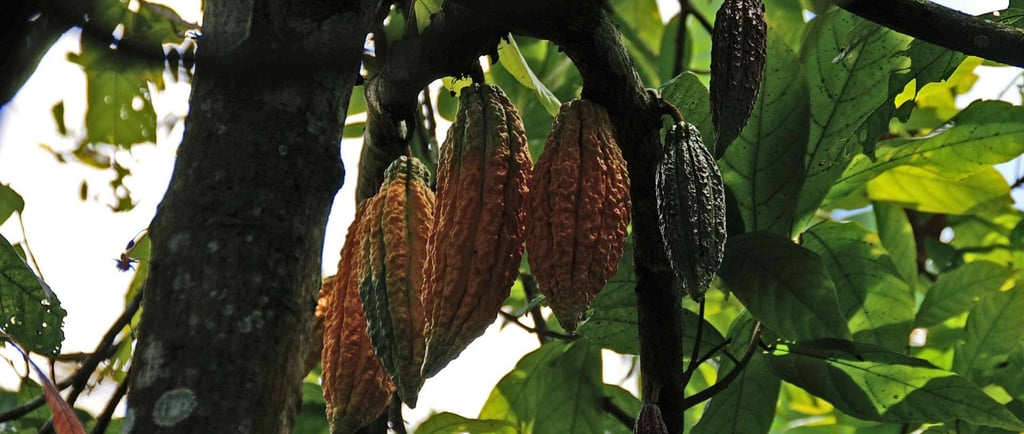
The cocoa history stretches back thousands of years, long before chocolate became the everyday treat we know today. What began as a sacred, bitter beverage brewed by ancient civilizations in the Americas eventually grew into one of the most traded agricultural commodities on the planet. Tracing the history of cocoa means following its path from wild rainforest tree to royal currency to colonial cash crop to the multi-billion-dollar global industry it is today.
The Origins of Cocoa in South America
Contrary to popular belief, cocoa did not originate in Mexico. Genetic and archaeological evidence points to the upper Amazon basin, in present-day Ecuador, as the birthplace of the cacao tree (Theobroma cacao). Early inhabitants of the region, including the Mayo-Chinchipe culture, are believed to have been using cocoa as far back as 5,000 years ago, making it one of the oldest cultivated crops in the Americas. From there, cocoa cultivation and consumption gradually spread northward into Central America and Mesoamerica.
Cocoa Among the Olmec: The Earliest Chocolate Drinkers
The Olmec civilization, which flourished along the Gulf Coast of Mexico between roughly 1500 and 400 BCE, is widely credited as one of the first Mesoamerican cultures to prepare cocoa-based drinks. Archaeologists have found cocoa residue in ceramic vessels at Olmec sites, suggesting that cacao was already an important part of ritual and daily life well over 3,000 years ago. The very word "cocoa" is believed to have Olmec linguistic roots, later passed down through Mayan languages.
Cocoa in Maya Civilization: A Sacred Drink for Everyone
For the Maya, cocoa held deep religious and cultural significance. Cocoa pods were painted on temple walls, referenced in creation myths, and consumed during weddings, religious ceremonies, and civic events. Unlike many luxury goods of the time, chocolate in Maya society was not reserved solely for nobility; it was a staple enjoyed by most households, typically prepared as a thick, frothy drink combined with chili, honey, or cornmeal and poured back and forth between vessels to create foam.
Maya cocoa use dates back to at least 2000 BCE, and by around the 8th century CE, cocoa beans had also become a recognized form of currency, used in trade and tribute across the region.
Cocoa and the Aztec Empire: Currency of the Gods
By the time the Aztec Empire rose to power in central Mexico (14th–16th century CE), cacao had become deeply embedded in political and economic life. The Aztecs, who could not grow cacao in their highland capital, obtained it through trade and as tribute from conquered territories, including from the Maya, who were required to pay taxes in cocoa beans.
The Aztecs called their chocolate drink xocolatl, meaning "bitter water," and believed ccoca was a gift from the god Quetzalcoatl. It was consumed as an energizing tonic, a ceremonial offering, and reportedly even given to warriors before battle. Aztec rulers, most famously Montezuma II, were said to drink large quantities of spiced chocolate daily. Cocoa beans were so valuable that they functioned as currency, used to purchase food and goods throughout the empire at times considered more valuable than gold itself.
European Discovery and the Spanish Conquest
Cocoa first reached European awareness following contact between Spanish explorers and Mesoamerican civilizations in the early 16th century. While the exact circumstances are debated by historians, the most commonly cited account credits the conquistador Hernán Cortés with encountering chocolate at the court of Montezuma and later bringing cocoa beans back to Spain following the fall of the Aztec Empire in 1521.
Once in Spain, chocolate was reworked to suit European tastes—mixed with cane sugar, cinnamon, and other spices and served hot rather than cold. By the late 1500s, chocolate had become a fashionable indulgence among Spanish nobility, and Spain formally began importing cocoa by the end of the 16th century.
Chocolate's Spread Across Europe
For nearly a century, Spain guarded its chocolate-making knowledge closely. Eventually, as trade, exploration, and royal marriages connected European courts, chocolate spread to France, Italy, England, and beyond during the 17th century. It remained an expensive luxury enjoyed almost exclusively by the aristocracy, served in exclusive chocolate houses that functioned much like the coffee houses of the era.
Rising European demand had a darker consequence: colonial powers began establishing cocoa plantations across their tropical territories in the Caribbean, South America, and eventually West Africa and Southeast Asia—plantations that, for centuries, relied heavily on enslaved and forced labor.
The Industrial Revolution and the Birth of the Chocolate Bar
Chocolate remained a beverage for roughly 3,000 years of its history. That changed dramatically in the 19th century with the arrival of industrial technology. In 1828, Dutch chemist Coenraad van Houten developed a press capable of separating cocoa butter from roasted cocoa beans, producing a fine cocoa powder and paving the way for more affordable, consistent chocolate products. This innovation, known as "Dutch processing," also reduced the drink's natural bitterness.
Later in the century, chocolatiers in Switzerland and England pioneered the solid chocolate bar as we recognize it today, along with milk chocolate and conching techniques that produced smoother textures. Mass production techniques transformed chocolate from an aristocratic luxury into a product accessible to the growing middle class.
Cocoa in the Modern Era
Over the 20th and 21st centuries, cocoa cultivation shifted decisively toward West Africa, which now supplies the majority of the world's cocoa beans, alongside significant production from South America and Southeast Asia. Today, cocoa is grown almost exclusively by millions of smallholder farmers across the tropics, and its beans travel through a complex global supply chain—from fermentation and drying at the farm to grinding and processing to the finished chocolate products sold worldwide.
What was once a sacred ritual drink in ancient Mesoamerica is now one of the world's most widely traded agricultural commodities, with global demand continuing to rise even as the industry grapples with challenges around sustainability
Looking to source premium bulk cocoa ingredients for your factory? Check out our complete premium cocoa products to discover our full range of natural cocoa powder, alkalized cocoa powder, cocoa butter, and cocoa mass. Curious about the origins of cacao itself? Discover our article on Who Created Chocolate to learn how ancient Mesoamerican civilizations first shaped the chocolate we enjoy today.


Cocoa Prime
Committed to bring the finest
Indonesian Cocoa to the world
Copyright © 2026 Cocoa Prime
Contact us:
Jl. Letnan Sutopo, Serpong, Tangerang
PHONE: +62-881-0104-79948